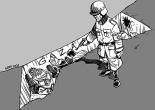
Gaza, Gaza: Yossi Wolfson On Israel’s Warfare Against the Palestinians

Yossi Wolfson’s clear-eyed description of the hafrada regime’s policies in the siege of Gaza and the too-little mentioned exploitation of Gaza’s gas reserves: recommended read. Boldface emphasis is editorial. This article appears in the very worthwhile Challenge magazine, Issue 107, January/February 2008

gaza_coffins.jpg
Gaza City, January 8, 2008. Empty coffins symbolize 62 patients who have died since June because Israel denied them access to medical treatment outside Gaza. Photo by Wissam Nassar

Yossi Wolfson, Economic Warfare in Gaza

NO MORE LIES or twisted tongues. Israel is saying at last what, in the past, it always refused to acknowledge: its war is against the Palestinian population.Until now, in discussions about the separation wall, closures, blockades, house demolition, and other sorts of collective punishment, the State Attorney’s Office lacked the gumption to admit in court that the aim of such measures is to harm civilians. It always came up with convoluted security claims in order to present some vital military necessity for the sake of the War against Terror. Harm to the population was described as a regrettable side effect.

But now a Rubicon has been crossed. Read the rest of this entry »

Having your yellowcake and dumping it too: Australia’s nuclear geopolitics and the US alliance

Route map of the GhanWill central Australia be the new site for world nuclear waste storage, mostly from the US, and serve to displace Aboriginal Australian communities in the Northern Territory outback? An interesting piece from my teaching colleague Alison Broinowski, published in NewMatilda in two parts, speculates about such a possibility.

Recently extended, the north-south railway that cuts vertically through the Australian continent may also be related to the sudden federal government intervention into indigenous communities, Alison writes. The rail link happens to run past remote Aboriginal communities in which Native Title has been suspended by the federal government (ostensibly on welfare grounds which have long existed), and seen as a land-grab.

The strategic significance of the railway extension—built by Halliburton subsidiary KBR—is that it passes between the largest uranium deposits in the world. The vertical rail link across the Australian landmass has long been considered economically unviable, but its construction for transporting loads of radioactive uranium—to as yet unannounced nuclear waste dumps along this axis—would explain its sudden commercial and/ or strategic viability.

In part one, Alison writes:

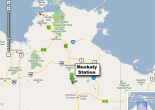
Always considered uneconomic, the rail link from Alice Springs to Darwin was suddenly found to be viable in 1999. A government/business partnership undertook to build it for $1.3 billion. FreightLink, a consortium of foreign and local investors that owns the railway, with a 50 year contract to run its freight operations, is a joint venture between 11 participants including Kellogg Brown Root (KBR, 36.2 per cent), Barclay Mowlem (13.9 per cent), and John Holland (11.4 per cent). Read the rest of this entry »

In Somalia, It’s The Blood Money, Stupid! by Amina Mire

Another valuable and urgent piece on Somalia with thanks to Amina Mire for sending it. She writes about the underexamined role of China’s scramble for Africa’s natural resources, in addition to African Union (AU) troops in Somalia serving as a mercenary army in service to foreign forces determined to “gain ownership over Somalia’s unexplored natural resources and install a puppet US friendly regime”.

“A Prayer of Shame:” In Somalia, It’s The Blood Money, Stupid!

meles-zinawi.jpg

Africa’s Leaders Are Shoulder to Shoulder and Hips on Hands with Meles Zinawi..1 Read the rest of this entry »

Greenback and the Capital of Empire Part I

us-soldiers-raise-oil-rig.gif

Violence can only be concealed by a lie, and the lie can only be maintained by violence.
–Alexander Solzhenitsyn

War is a racket. It always has been. It is possibly the oldest, easily the most profitable, surely the most vicious.
–Marine Corp General Smedley Butler

Dollar hegemony: in part, its the notion that the US imperium is not simply predicated upon oil, but the supremacy of the dollar; in particular, the petrodollar. It goes toward describing how the US in particular requires a steady diet of petrodollars to maintain the massive debt and burgeoning trade deficit that underpins unprecedented levels of consumerism and consumption — the famous “way of life” that George Bush Senior notably declared was “non-negotiable” during his Presidency.

tohby-riddle-war-cartoon.jpgNon-negotiable to the neocons, perhaps, but unsustainable to many in the reality based community, with claims of imminent dollar decline, if not collapse.

People who have written extensively on the topic include (but are not limited to — see suggested Further Reading List to be appended) Mike Whitney, William Clark and Ron Paul.

As Mike Whitney puts it, the dollar is also the Achilles heel of the empire: “When the dollar collapses, the baling-wire of economic coercion that keeps the empire sewn together will quickly unravel.”

Let’s examine that claim further. Here, I review some of their recent writing this week on the US dollar, the Federal Reserve and dollar hegemony, as well some observations on the still under-examined topic of an Iranian oil bourse and the implications of the switch to Euros.

Mike Whitney continues his interesting prognostications on what he sees as the doomed dollar. In Doomsday for the Greenback (ICH, 10 April) he updates his 2005 article by the same name, in which he wrote:

America’s capital is not in Washington DC. In fact, it is not geographic location at all. It is the greenback, the epicenter of the global rule. The dollar is the cornerstone upon which the mighty pillars of empire rest.

At the same time, the greenback is the greatest swindle in human history; a worthless scrap of paper buried beneath a mountain of debt. It is only through the skillful mix of politics, diplomacy, and brute force that the grand deception is maintained. As America’s fortunes grow more tenuous, the probability of attacks on the dollar will increase exponentially. Even now, nations are conspiring to knock the dollar from its towering summit and introduce a more equitable system.

At present, the greenback serves as the world’s reserve currency, the main medium of exchange. This allows the US to pile up enormous debt while avoiding the pitfalls of skyrocketing interest rates or hyper-inflation. The $2 billion of borrowed wealth that props up the faltering empire every day comes primarily from the exporting powerhouses Japan and China. This means that America’s profligate spending is financed by the labor of some of the most poorly paid workers in the world.

Ironically, sweatshop workers in Kwantung Province are now bankrolling the criminal occupation of Iraq by facilitating America’s massive trade deficits. Read the rest of this entry »

To bee or not to bee: our survival depends on it

Addendum: See also To bee or not to bee II (14 April)

bee.jpg

An interesting article in Spiegel asks whether Genetically Modified crops are responsible for the alarming decimation of bee populations. Why is this important? As Albert Einstein once noted (quoted in the article): “If the bee disappeared off the surface of the globe then man would only have four years of life left. No more bees, no more pollination, no more plants, no more animals, no more man.”

Article excerpt:

Mysterious events in recent months have suddenly made Einstein’s apocalyptic vision seem all the more topical. For unknown reasons, bee populations throughout Germany are disappearing — something that is so far only harming beekeepers. But the situation is different in the United States, where bees are dying in such dramatic numbers that the economic consequences could soon be dire. No one knows what is causing the bees to perish, but some experts believe that the large-scale use of genetically modified plants in the US could be a factor.

Read the rest of this entry »

Israeli Apartheid Comes to New Jersey

A very good piece by Saifedean Ammous in the Columbia Daily Spectator (rep. at Alternet), worth posting here in its entirety.

Israeli Apartheid Comes to New Jersey
By Saifedean Ammous | 5 March, 2007

It was a cold Sunday morning in Teaneck, N.J. Some two-hundred-odd Jewish-Americans were entering the Orthodox synagogue Congregation B’nai Yeshurun where they were to hear a sales pitch by the Amana Settlement Movement aimed at convincing them to buy homes in illegal Israeli settlements. America, the land that gave the world the separation of church and state, is hosting an auction where only members of one religious group can buy property.

And here I am, a Palestinian who grew up hundreds of meters away from some of these very settlements. I cannot buy any of these houses and am not admitted into the auction room. Literally and figuratively left out in the cold, I light a cigarette and get over it immediately; being denied entry is not an entirely novel experience for a Palestinian.

A group of around 50 pro-peace activists gather outside to protest the auction. Rabbi Steven Pruzansky comes out to speak to journalists; he doesn’t seem to understand the controversy. “Everyone can buy land anywhere. I was in the Bahamas and they were selling land; in Florida they sell land to anyone, why can’t we buy land in Israel?” When a journalist mentions to him that these are colonies for Jews only, he says that he prays hard for peace, and looks forward to the day when Jews and Arabs can live together, but for now this is hard because of the “security situation.” It doesn’t occur to him that this “security situation” may itself be the result of these exclusive colonies being built on stolen Palestinian land.

Read the rest of this entry »

Scott Ritter and Seymour Hersh on Iran

The long and the short, all most worthwhile. Former UN Weapons Inspector Scott Ritter and Pulitzer Prize winning journalist Seymour Hersh draw on their expertise and experience to offer important insights and cut through the cant and disinformation on Iran.

While lengthy, the ninety minute C-Span 2 video is great to run and listen to in the background if doing other work — highly recommended. Listen particularly at the 35 minute, 1 hr:04 min, and 1 hr:10 min mark on the C-Span video (third video below). What Ritter says at the 1 hr:04 minute mark (just after the one hour mark in Question Time) is, I’ll wager, one of the most important things you’ll hear.

The transcript of this talk (sans Question Time) is available here and a choice quote featured here.

In the blogosphere, also check out Homeyra’s and the Fanonite’s recent entries on this important topic, both bringing attention to Ritter’s urgent work on Iran. The Fanonite has also added a few reservations about Hersh’s reliance on anonymous sources in his post reviewing Hersh’s recent New Yorker article on US-Saudi-Israeli designs for the Middle East.

Amy Goodman interviews Scott Ritter, Democracy Now—Part 1 (8:19) and Part 2 (8:42)

Democracy Now, Part One:

Democracy Now, Part Two:

Scott Ritter with Seymour Hersh on C-Span2’s Book TV (90 minutes)
New York Society for Ethical Culture | 16 Oct 2006

Read the rest of this entry »

Neocons growling on Iran

huffaker-us-intell-on-iran.gif

Sandy Huffaker, caglecartoons.com

Recent Press Picks

* Seymour Hersch, The Redirection, New Yorker (25 Feb 2007):

To undermine Iran, which is predominantly Shiite, the Bush Administration has decided, in effect, to reconfigure its priorities in the Middle East. In Lebanon, the Administration has cooperated with Saudi Arabia’s government, which is Sunni, in clandestine operations that are intended to weaken Hezbollah, the Shiite organization that is backed by Iran. The U.S. has also taken part in clandestine operations aimed at Iran and its ally Syria. A by-product of these activities has been the bolstering of Sunni extremist groups that espouse a militant vision of Islam and are hostile to America and sympathetic to Al Qaeda.

* John Amato, Seymour Hersh: Negroponte–Iran Contra—Funds–al Qaeda…Oh my!, Crooks and Liars (25 Feb)

* Chris Floyd, Bush Faction Arming AlQuafa to Thwart Iran, Empire Burlesque (26 Feb)

* Trita Parsi has a valuable site of Iran politics related article links

* Michael Smith and Sarah Baxter, US generals ‘will quit’ if Bush orders Iran attack, The Times (25 Feb):

SOME of America’s most senior military commanders are prepared to resign if the White House orders a military strike against Iran, according to highly placed defence and intelligence sources.

Tension in the Gulf region has raised fears that an attack on Iran is becoming increasingly likely before President George Bush leaves office. The Sunday Times has learnt that up to five generals and admirals are willing to resign rather than approve what they consider would be a reckless attack.

* Israel Insider staff, Report: Gulf states give Israel ok to use airspace for strikes against Iran, Israel Insider (25 Feb)

* Booby Traps Detonated by US Remote Controls, FarsNews (20 Feb)

* Ambassador Rasoul Movahedian, Iran is a force for peace, Guardian (22 Feb):

The latest salvo of rhetoric against Iran betrays a grand design to demonise the country and trigger a new adventurism in the highly sensitive Persian Gulf region. Again and again the “Iranian threat” is invoked as part of a neocon agenda to deepen US military involvement in the area. But its goal - to downgrade Iran’s role in the region - is both implausible and ill founded.Iran, by contrast, has demonstrated throughout its history a belief in constructive engagement in international relations, at the same time as holding firm to its right to retain its important regional role. Read the rest of this entry »

Spotlight on Sherffius

John Sherffius, Cartoonist for the Boulder Daily Camera.

A feature selection of recent cartoons from Cagle’s Cartoon site

Click on thumbnails for full-size (if using Firefox or IE7, you can also open in a new tab)

sherffius-branches-of-bushes-govt.jpgsherffius-by-our-own-hands.jpgsherffius_-iran-iraq-warometer.jpg

sherffius-20000-surge-bush-bubble.jpgsherffius-bushrankenstein.jpgsherffius-diamond-cuts.jpg

sherffius-earth-burns-exxon-earns.jpgsherffius-emperor-bush-no-clothes.jpgsherffius-unle-sam-is-watching-you.jpg

A tale of two cities: Baghdad

It was the best of times (for war profiteers), it was the worst of times ….

Inside the Green Zone, the caricatures of American consumptive popular culture are on display while ordinary Iraqis are dying and enduring untold suffering under occupation.

One third of Iraqis are now reported to be living in poverty, clean drinking water is becoming scarce, and the lack of effective policing is necessitating vigilante patrols. Last month alone, 2000 people died in Iraq.

Haven’t these people suffered enough? Iraqis want US troops out. A majority of Americans now want the same. Liberation? Security? Don’t make me laugh. This is all about keeping Iraq safe for the war profiteers, and to maintain Israel’s monstrous regional hegemony. This is the awful (rather than the lawful) reality. Appalled? Disgusted? You bet.

This is far from the Democratic Reformation touted in official rhetoric, it is (and has been from the outset) an outright Democratic Deformation. It is a continuation of the policymaking that the US neocons have hijacked and distorted into their depraved nihilistic war crimes. Sadly, this only draws upon a substantial section of bellicose popular culture that is devolving into an apparently more decadent and degenerate psychopathology, as Justin Raimondo opines.

In disgraceful contrast to the poverty and suffering of most of the Iraqi population who were promised liberation and a functioning political economy rather than outright theft of its resources, take a look at life inside the Green Zone and the largest US embassy in the world.

Herein lies an abominable band-aid of crass cultural comfort and vulgar profligacy from the war profiteering corporations like Bechtel and Halliburton (where even the bars are named after the corporations), in return for ever increasing numbers of Americans troops and stomach-churning high numbers of Iraqis sacrificed for these odious war profiteers and the unsustainable “American way of life”. Even the water is shipped in.

The Guardian (19 Feb) features the first of three extracts from Rajiv Chandrasekaran’s new book, Imperial Life in the Emerald City.

A US soldier jumps from a platform as he enjoys Saddam Hussein's swimming pool at the Republican Palace

A US soldier jumps from a platform as he enjoys Saddam Hussein’s swimming pool at the Republican Palace. Photograph: Marco Di Lauro/Getty

Unlike almost anywhere else in Baghdad, you could dine at the cafeteria in the Republican Palace in the heart of the Green Zone for six months and never eat hummus, flatbread, or a lamb kebab. The palace was the headquarters of the Coalition Provisional Authority (CPA), the American occupation administration in Iraq, and the food was always American … A buffet featured grits, cornbread and a bottomless barrel of pork: sausage for breakfast, hot dogs for lunch, pork chops for dinner. The cafeteria was all about meeting American needs for high-calorie, high-fat comfort food.

None of the succulent tomatoes or crisp cucumbers grown in Iraq made it into the salad bar. US government regulations dictated that everything, even the water in which hot dogs were boiled, be shipped in from approved suppliers in other nations. Milk and bread were trucked in from Kuwait, as were tinned peas and carrots. The breakfast cereal was flown in from the US.

…The Green Zone also provided its own good time. The CPA had a “morale officer” who organised salsa dancing lessons, yoga classes and movie screenings in the palace theatre. There was a gym with the same treadmills and exercise machines you would find in any high-end health club in America. Read the rest of this entry »

Energy Addiction

Among his typically excellent essays, Curtis over at CSTF has recently posted another gem that I meant to link to earlier. Drawing upon Ivan Illich’s writing on energy and equity, Curt ponders our Addiction to Energy. Highly recommended.

Filibuster to End the War Now!

Sounds like a plan … See also Noam Chomsky on the US occupation of Iraq here, who argues that this administration ain’t planning to go nowhere, citing the largest US embassy in the world and economic profiteering interests.

It Only Takes 41 Senate Votes to End the War. Republicans Show the Way.

By John V. Walsh | Counterpunch | 9 Feb 2007

We hear over and over again that it “takes 60 votes to get something serious done in the Senate.” That is a lot of malarkey. It takes only one senator to begin a filibuster against any bill. And then it takes only 41 votes to uphold that filibuster and prevent any proposed law from coming to the floor.

Thus, the present authorization for defense funding in the coming fiscal year can be stopped cold if it contains funds for the war on Iraq. And this can be done by just one courageous Senator, backed by 40 colleagues.

Let me propose the following scenario. Just one Senator, Ted Kennedy or Russ Feingold or Robert Byrd, arises in the Senate and declares that he will filibuster the present defense authorization bill if it contains funds for the war on Iraq or Iran. That bill is then dead unless there are 60 votes (3/5 of the 100 Senators) to end the debate, i.e., to invoke cloture. That is it. Bush no longer has the funds to prosecute the war. He has to come back with a funding bill acceptable to the 41.

At the same time the filibustering Senator could put forth a resolution similar to Congressman McGovern’s in the House, which is aptly named “The Safe and Orderly Withdrawal Act.” It provides funds to ensure the withdrawal of U.S, forces from Iraq in a way that guarantees their safety, and no other funding for the war. If the opponents of our hypothetical, courageous Senator wish to oppose such legislation, let them go on record in so doing. They are then on record as refusing funds to bring the troops safely home. Read the rest of this entry »

The political economy of escalation

John Damien posits what he sees as the likely material motive to the madness in BushCo’s planned escalation.

While there may well be a intra-elite split in the US administration between the neolibs and the neocons along the axis of economically draining military misadventures, this commentary speculates more about material rather than martial motives in the political economy underpinning the intention to escalate the military madness.

It suggests that otherwise competing guns and butter interests might overlap rather than diverge.

Excerpted from John Damien, Bush Throws the Dice, ICH blogs, 27 January 2007

By funding the Iraq war and supporting Israel, Egypt and Jordan, the US pays an oil security tax running at least $100 billion per year. China doesn’t pay billions per year to secure their oil supplies. The Europeans collectively spend a fraction of the US amount on oil security.

At $60 barrel, the US is paying approximately $290 billion per year for imported oil. Plus the security tax. That tax includes deployments and operations beyond the Iraqi theatre. However, based on the public estimates that Iraq cost $100 billion last year , it would appear the US economy pays 30% more for oil as anyone else. Put another way, China pays $60 per barrel of imported crude oil. Adding the cost of oil security, America pays more than $90 for the same barrel of oil. Even the United States cannot keep this up forever.

Pressure is growing to do something about this situation. The economics are complicated, but the point is straightforward. The US dollar is trending lower in value as the price of oil is trending higher. At some point, America becomes non-competitive, putting the massive US debt at risk. As the currency goes lower, the value of the return on US investments drops relative to other economies. Lower investment return means less demand for the US dollar. The best way for George Bush to deal with this potential nightmare is to prevent it from happening. The best way to keep it from happening is to 1) lower the security tax by making the Middle East more stable, 2) ensure that the money spent on security actually buys something. That something might mean for a more stable oil supply than competitive countries, or a return to the US dollar as the only currency for energy trading.

Like the Middle East political situation, the economic outlook dictates decisive action by the US. The United States cannot continue indefinitely to pay more for oil than everyone else. As we have seen, there is nothing that can be done within the context of Iraq. The only course open to Bush is escalation.

John Damien concludes soberly:

The basic fact is that America controls nothing in Iraq, and little beyond. They have no ability to do anything more than wreck the remaining stability in the region. Nevertheless, because of perceived strategic necessity, economic exposure and dreams of greatness, the US Administration is planning action. The gambler is readying one last, grand wager.

BushCo and Big Oil Manipulating the Oil Reserve for Polls and Profit?

Eye-opening article by Thomas I. Palley: Manipulating The Oil Reserve in TomPaine.com (January 26, 2007). His bio:
Thomas Palley runs the Economics for Democratic and Open Societies Project. He is the author of Plenty of Nothing: The Downsizing of the American Dream and the Case for Structural Keynesianism. His weekly economic policy blog is at www.thomaspalley.com.

EXCERPT

2006 was the year that oil prices came close to breaching $80 per barrel. This was despite the fact that there were no significant supply interruptions and oil demand actually fell in industrialized countries. That raises the question of what caused the spike.

It turns out there is good reason to believe that record oil prices may be due to our own strategic oil reserve, which the Bush administration may have been manipulating to drive up prices for the benefit of its clients. This is something Congress must investigate, and here is some preliminary evidence.

Any finding of manipulation would go far beyond corruption and be close to economic treason, because when oil prices increase America must pay more for its imported oil. That, in turn, increases the trade deficit and our foreign debt. Alternatively, one can think of price manipulation as the equivalent of a tax increase on American families that is paid to foreign governments, including Iran. While some small energy scandals are under investigation by Congress, the big enchilada is the strategic oil reserve, which may have been “strategically” manipulated to drive up oil prices. The key to understanding this manipulation is demand and supply and oil storage capacity.

READ REST HERE