
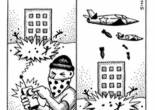
War’s Shopping Cart

An interesting look at the militarisation of the US economy from Nick Turse. While the US has long been a permanent war economy, the consumer dimension of the corporate overlap has not–until recently–been highlighted.

War’s shopping cart

Pepsi, Apple, Krispy Kreme and other consumer firms profit from Iraq too.

By Nick Turse | LA Times

Last month, a review of 2006 congressional financial disclosure statements by the nonpartisan Center for Responsive Politics found that lawmakers have as much as $196 million “invested in companies doing business with the Defense Department, earning millions since the start of the Iraq war.” An Associated Press article on the report, however, offered a caveat: “Not all the companies invested in by lawmakers are typical defense contractors. Corporations such as PepsiCo, IBM, Microsoft and Johnson & Johnson have at one point received defense-related contracts.”

But the Associated Press is wrong. The fact is that corporations such as PepsiCo, IBM, Microsoft and Johnson & Johnson are, indeed, typical defense contractors. To suggest that such firms, and tens of thousands like them, only receive defense-related contracts at the odd, aberrant moment is specious at best. Read the rest of this entry »

Job Market In A More Just World

Nice role reversal … Run time: a minute and a half. Thanks Forever Under Construction. From the new short film The Job written and directed by Jonathan Browning and produced by Screaming Frog Productions.

You may also be interested in:

Uncounted: the New Math of American Elections

A new documentary on election anomalies in the US and the dangers of electronic voting. Were the 2000 and 2004 stolen presidential elections episodic, or rather products of now more permanent, systemic vote-rigging features? Watch out for the eye-opening Tom Feeney-Clint Curtis segment (c. 50 minute mark), among other highlights.

UNCOUNTED is an explosive new documentary that shows how the election fraud that changed the outcome of the 2004 election led to even greater fraud in 2006 - and now looms as an unbridled threat to the outcome of the 2008 election. This controversial feature length film by Emmy award-winning director David Earnhardt examines in factual, logical, and yet startling terms how easy it is to change election outcomes and undermine election integrity across the U.S. Noted computer programmers, statisticians, journalists, and experienced election officials provide the irrefutable proof.

See also the Uncounted website and HBO’s Hacking Democracy.

80 minutes

Read the rest of this entry »

The Story of Stuff

Annie Leonard’s simplified, straightforward 21 minute video on the true cost of our consumer products, The Story of Stuff (see dedicated website for a synopsis and more info).

Once you get used to the “gee, like, you know” teen-like tone and the preachiness about it all not being peachiness, this is a worthwhile video suitable for all ages, with a stronger second half.

Ten Reasons Why “Save Darfur” is a PR Scam to Justify the Next US Oil and Resource Wars in Africa

bendib-divest-from-sudan.jpgBruce Dixon is another who makes the case that the “Save Darfur” campaign is more or less a “humanitarian imperialism” front to be used to justify intended neocon oil and resource wars in the African continent, particularly in the resource-rich Sudan.

Cartoon © Khalil Bendib, All rights reserved. Click on thumbnail for full-size

See also:

IPS, War in the Name of Peace: Interview with Jean Bricmont, author of ‘Humanitarian Imperialism’; Paul de Rooij, “Humanitarian Wars” and Associated Delusions (review of Bricmont); Kevin Funk and Steve Fake, Divestment and Darfur: Solution or Diversion?; Mahmood Mamdani, The Politics of Naming: Genocide, Civil War, Insurgency (and here for an interview on Democracy Now!); Ned Goldstein, Exploiting African Genocide for Propaganda; Roger Howard, Where anti-Arab prejudice and oil make the difference; Alexander Cockburn, Gaza and Darfur: When Will Kristoff Go to the Occupied Territories?; William Reed, How to Save Darfur; Keith Harmon Snow, The US’s War in Darfur.

The star-studded hue and cry to “Save Darfur” and “stop the genocide” has gained enormous traction in U.S. media along with bipartisan support in Congress and the White House. But the Congo, with ten to twenty times as many African dead over the same period is not called a “genocide” and passes almost unnoticed. Sudan sits atop lakes of oil. It has large supplies of uranium, and other minerals, significant water resources, and a strategic location near still more African oil and resources. The unasked question is whether the nation’s Republican and Democratic foreign policy elite are using claims of genocide, and appeals for “humanitarian intervention” to grease the way for the next oil and resource wars on the African continent. Read the rest of this entry »

Having your yellowcake and dumping it too: Australia’s nuclear geopolitics and the US alliance

Route map of the GhanWill central Australia be the new site for world nuclear waste storage, mostly from the US, and serve to displace Aboriginal Australian communities in the Northern Territory outback? An interesting piece from my teaching colleague Alison Broinowski, published in NewMatilda in two parts, speculates about such a possibility.

Recently extended, the north-south railway that cuts vertically through the Australian continent may also be related to the sudden federal government intervention into indigenous communities, Alison writes. The rail link happens to run past remote Aboriginal communities in which Native Title has been suspended by the federal government (ostensibly on welfare grounds which have long existed), and seen as a land-grab.

The strategic significance of the railway extension—built by Halliburton subsidiary KBR—is that it passes between the largest uranium deposits in the world. The vertical rail link across the Australian landmass has long been considered economically unviable, but its construction for transporting loads of radioactive uranium—to as yet unannounced nuclear waste dumps along this axis—would explain its sudden commercial and/ or strategic viability.

In part one, Alison writes:

Always considered uneconomic, the rail link from Alice Springs to Darwin was suddenly found to be viable in 1999. A government/business partnership undertook to build it for $1.3 billion. FreightLink, a consortium of foreign and local investors that owns the railway, with a 50 year contract to run its freight operations, is a joint venture between 11 participants including Kellogg Brown Root (KBR, 36.2 per cent), Barclay Mowlem (13.9 per cent), and John Holland (11.4 per cent). Read the rest of this entry »

Chris Floyd on the Ethnic Cleansing of Iraq

With very few honourable exceptions, the Congressional RepublicoDemocratic War Party is at one in their policy toward Iraq. Those who expected Democratic leaders to suddenly recover backbone after the mandate given to them after the November elections and inject sanity into the Bush administration’s murderous Iraq policy were going to be courting disappointment.

As a result, the destruction, likely enclavisation and ethnic cleansing of Iraq continues apace. Over 1,000,000 Iraqi and over 3000 US lives have been lost since the 2003 invasion, sacrificial lambs slaughtered for Empire at the ungodly altar of neocon-neoliberal wealth and privilege, particularly, but not limited to, its Washington and Tel Aviv branches.  (See also the Nir Rosen interview in “Iraq Does Nor Exist Anymore“)

Chris Floyd has this pegged right in his important piece Bipartisan Paradise: Liberals, Bush Unite in Ethnic Cleansing of Iraq, in which he writes:

It is now obvious that one impetus behind the “surge” was to accelerate the “ethnic cleansing” of Iraq. Given the manifest failure to establish a strong central government to serve as a client state, the conquerors now find it easier to deal with separate ethnic enclaves, which can police themselves, shake out their own internal conflicts (however bloodily) and thus establish some kind of solid leadership that can cut deals and guarantee investments. Most of the measures taken during the “surge” seem aimed precisely at ethnic cleansing: the increased support of the Iraqi government security forces — which are largely Shiite militias — has been matched with what some see as the lunatic policy of arming Sunni militias.

The latter is indeed a lunatic policy — if your aim is to establish security and political rapprochement in Iraq. And although the leaders of the United States are indeed a gang of depraved moral idiots, they are not lunatics. Even they could see the folly of such a course — again, if the aim was actually security and political cohesion. Thus one can only conclude that this is not their aim, that their aim is indeed to exacerbate ethnic conflict, to foment more violence, in what amounts to a stealth operation of ethnic cleansing.

This serves two main purposes: first, as noted above, it will help shake the country out, eventually, into more manageable enclaves — each one stronger and more cohesive than the current government (which is largely a fictional notion at this point), yet weaker, and more malleable, than any stable and legitimate central government would be. And since the only kind of central government that could achieve stability and legitimacy in the eyes of all Iraqis would be one which was genuinely sovereign, truly independent from American domination, we will never see such a government in Baghdad as long as U.S. troops are in Iraq.

Which brings us to the second purpose of the “surge’s” arming of sectarian gangs: to maintain a level of violence and chaos that would “justify” the continuing presence of American troops in Iraq. A permanent military presence is one of the overriding goals of the invasion, set down long before the war, before 9/11, even before the loser Bush was given the presidency by five Supreme Court justices (two of whom had family members working for the Bush operation). Therefore, to the Bushists, any measure is justified that will keep American troops in Iraq — including fomenting bloody sectarian conflict and carrying out ethnic cleansing. Read the rest of this entry »

The Yes Men on Bill Moyers

The satirical culture-jammers The Yes Men interviewed on Bill Moyers Journal (20 July 2007). I don’t know how they can keep a straight face in their hilarious impersonation escapades (probably because what they parody—neoliberal globalisation— is its own caricature!) but their work is much appreciated, especially as the humour actually works to bring truths to the fore. See also Homey’s recent profile on these funny tricksters.

Part One (9.40)

Part Two (8.30)

Ethnic cleansing by L’Oreal: “Because you’re worth less?”

At some point last year, I was introduced to Amina Mire’s work on skin bleaching. I was reminded of Amina’s essay Pigmentation and Empire when coming upon two of these vids flogging skin-lightening creams by way of Graeme’s blog, and I’ve borrowed two of the puns from Graeme’s readers who share my disdain for this phenomenon of companies such as L’Oreal and Unilever Hindustan (who own the ‘Fair and Lovely’ brand) helping to make women feel as if they don’t measure up and need to lighten their skin to somehow be beautiful.

Is this blamecasting companies for a culture that has existed for thousands of years in some places? India’s caste systems were well entrenched long before colonialism set in, but it is also true that these cosmetics corporations are exploiting and sustaining it. Both the culture and the companies are part of a system that needs deeper examination — this post is merely a brief introduction in which I do not assign singular culpability as much as invite you to consider the history and politics further and to decide for yourself.

bi-white.jpgThe practise of skin-whitening can be found everywhere but is particularly common in India, Asia, Africa and the United States. Going by two of the advertisements below, it looks like a similar market is being created in the Middle East.

Living in a country such as Australia where tanned skin is viewed as healthy and beautiful and Caucasians are often at a natural disadvantage to their Mediterranean (olive) and Aboriginal (black and brown-skinned) fellow citizens, the beauty ideal is the opposite. This is a problem for Caucasians particularly and all Australians generally as we have the biggest rates of skin cancer in the world.

I can only hope each of us values our natural beauty and diversity. Brown skin is gorgeous; olive is awesome; black is beautiful, white too is beautiful. I can’t say I buy into the argument that these products simply cater for a preexisting market, though the literature on India in particular seems to examine the line that internalised racism is ingrained in the culture. I think these companies help create and perpetuate that market by making women (and men) feel less than adequate with the beauty they already possess, as illustrated in the advertisement’s story-lines of brown skin=rejected for job; lighter skin=happy and successful. (See appended article links)

Each of the advertisements is less than a minute in duration. The three skin lightening advertisements are followed by a related and heart-breaking 7 minute video entitled ‘A Girl Like Me‘ produced by Kiri Davis who does a superlative job. It shows how socialising young girls starts even before they encounter the cosmetics counter and the burgeoning industry that manufactures, exploits and inflates ethnic insecurities.

Addendum: some off-blog discussion has explored how a preference for lighter skin may also have been cultivated with one’s class and station in life (ie working in the fields–thanks Print), with the lighter skin of the indoorsy aristocracy being imitated by labouring folk. While this is a racially charged topic and race is a most important and key plank; class, culture, health, psychology and other variables certainly come into play.

‘Fair and Lovely’ Middle East

‘Fair and Lovely’ II

‘Fair and Lovely’ India (double click on this one to view at YouTube site)

A Girl Like Me

Related articles

Johan Galtung: Conflict and Civilisation

Thanks to Agent 99 for pointing out the updated link, the first location of which had lapsed (also updated on audio page). I’ve taken the opportunity to upload this talk again by Johan Galtung which I attended last year. His hybrid-but-mostly-Norwegian accent may make him sound like Inspector Clousseau as our friend notes, but his reflections are always worthwhile and enriching. (RT 81 m)

Galtung talks about enacting a positive peace through meaningful dialogue, about spiritual syncretism and an alliance of civilisations, with reference to the Danish cartoon controversy and other topical conflicts. This elder spokesman and founder of peace studies delivered this address at the Brisbane Festival of Ideas on the 31 March 2006.

Original .mp3 url

Relevant links:

Further links: Conflict transformation

Hariri Tribunal: sarcastic — and serious — takes

Cartoon by Leba-none

lebanone_rule02.jpgFirst, sarcastic humour alert. You may know that the supremely representative UN Security Council has voted to go ahead with a spurious court to prosecute the murder two years ago of former Lebanese prime minister Rafiq al-Hariri (a.k.a. Let’s Pin the Blame on Syria—one must question why the murder of Hariri merits an international tribunal but the war launched by Israel against Lebanon last year does not, nor the other well known cases of “targeted assassinations” by the US or Israel).

Ten council members voted for the US, France and UK sponsored U.N. resolution that would unilaterally establish a tribunal to investigate the 2005 Hariri murder.

Five countries abstained: Russia, China, Indonesia, Qatar, and South Africa, who argued that the council was exceeding its authority and interfering in Lebanese affairs (PM Foaud Siniora wants the Tribunal but Lebanon’s Parliament had not approved it).

This tongue-in-cheek commentary about the Tribunal is courtesy As’ad Abu Khalil of the Angry Arab News Service (see yet another instance of the sarcastic humour here, in two short lines: KAPOW! At least we Lebanese can laugh at ourselves).

Exhibit # One

It was ironic to watch the quasi-debate at the United Nations Security Council today. Was it amusing to watch the delegate of South Africa defend the Lebanese constitution and sovereignty while the Lebanese delegate was pleading for the UN to violate the sovereignty of Lebanon? Lebanon today has the equivalent of Babrak Karmal government.

Exhibit # Two:

The UNSC council has just passed a resolution to establish an international tribunal to find and punish the killers of Rafiq Hariri.

As is well-known, this tribunal will

1.) end all manners of Syrian intervention in Lebanon;

2.) finally produce a sovereign and free Lebanon;

3.) force the Lebanese to love one another;

4.) will also produce unprecedented prosperity for all the Lebanese;

5.) will address the underlying causes of all conflicts in Lebanon;

6.) will undermine sectarianism in society and in the Lebanese political system;

7.) will end the massive corruption that plagues the Lebanese administration;

8.) will ensure that all Lebanese groups and militias are disarmed;

9.) will defeat the Iranian plot in the region.

However, the tribunal, as is well-known, will not find nor will it punish the killers of Rafiq Hariri although the UN investigative team is examining soil samples in Saudi Arabia. Stay tuned.

On a more serious and less superficial note, AbuKhalil hypothesises that the Hariri-Bandar-Bush (Bush being shorthand for Cheney, Abrams and the US neocons) plans spearhead a shift in the power game dynamic, particularly in attitudes toward Iran. The twists and turns that are being played out are certainly confusing seasoned observers and neophytes alike. AbuKhalil draws upon AUB academic Ahmad Musalli who thinks the status of Fatah al-Islam has been changed from friend to foe because a “deal” was brokered with Iran, so the shadowy militia group were cut loose. If so, will the deal with Iran, too, be cut loose when political expediency changes course?

As Chris Floyd writes, these expendable militia groups are pawns in a deadly game that is creating chaos and causing casualties in an already battered region. Neocons continue their destructive policies of bumbling regional re-design, benefiting nobody but the corporate war profiteers. “Fight al Qaeda in Iraq; fund al Qaeda in Lebanon; arm and train Shiite militias and death squads in Iraq, then fight Shiite militias and death squads in Iraq — what’s the difference, as long as the game goes on, the waters stay murky with blood, and the war profits keep rolling in?”

Subversive cartoons follow — so subversive I’ve tucked them away after the ‘More’ jump.

Social Bookmarks:

Read the rest of this entry »

Lamb US Airbase Rationale Supported By WMR

The Wayne Madsen Report now also carries the Lamb piece; they reported on this some months ago and have written in support of his assertions. A number of blogs and press sites such as the Peoples Voice carried the WMR story when it appeared. Lamb has certainly reignited interest in the airbase and US plans for the regions, and our increased scrutiny can only be a good thing, whether these plans are in the works or not.

kleiaat.jpgKleiaat airbase

From the Wayne Madsen Report last month (.pdf — see p. 2):

April 16, 2007 — WMR was the first to report on the establishment of a major US airbase in northern Lebanon to facilitate logistics for America’s planned long-term stay in the Middle East, including the occupation of Iraq.

On July 21, 2006, we reported, “With the carrying out of the Clean Break by Israel and the United States, profits for companies like Halliburton are bound to skyrocket. The Israeli attack on Lebanon is already estimated to have resulted in $2 billion in damage to Lebanon’s infrastructure. WMR previously reported that Jacobs/ Sverdrup has been promised a lucrative Pentagon contract to build a large U.S. airbase in northern Lebanon.

The editor reported on March 11, 2005:

“Washington and Jerusalem media experts spun Hariri’s assassination as being the work of Syrian intelligence on orders from President Bashar Assad. However, a number of Middle East political observers in Washington claim that Hariri’s assassination was not in the interests of Assad, but that the Bush and Sharon administrations had everything to gain from it, including the popular Lebanese uprising against the Syrian occupation. Lebanese intelligence sources report that even without a formal agreement with Lebanon, the contract for the northern Lebanese air base has been let by the Pentagon to Jacobs Engineering Group of Pasadena, California.Other construction support will be provided by Bechtel Corporation. Read the rest of this entry »

‘Going blackwater’: profiteering and private armies

war-profiteers.jpg

It has been quite a week for the US Congressional House Appropriations Committee (defense subcommittee), with two investigative journalists delivering their testimonies on war profiteering in the past week. The week has also seen a majority of Iraqi legislators, as US-installed and backed as they are, vote to reject the occupation of their country and call for a withdrawal. robert-greenwald.jpg

jeremy-scahill.jpgThe full testimony transcript of filmmaker Robert Greenwald, who brought us the documentary Iraq for Sale, can be found here and that of Jeremy Scahill, author of Blackwater: The Rise of the World’s Most Powerful Mercenary Army, here, with videos and excerpts below.

There are 126,000 private contractors currently deployed in Iraq, a force Scahill has described as “the world’s most powerful mercenary army” and an unaccountable one at that. Such a heavy reliance on private contractors — they constitute almost half the military US presence — has enabled the Bush administration to nearly double the number of U.S. forces in Iraq without the general knowledge of U.S. taxpayers.

Quite apart from the immoral and illegal invasion of Iraq, there has also been much known profiteering, corruption and waste and egregious abuses of the procurement system and unscrupulous practises. Without impugning all of them, a substantial number of contract workers in Iraq are committing crimes — including killings — with impunity and wasting millions of dollars.

Greenwald told lawmakers that these contractors were among the interrogators and translators who tortured prisoners at Abu Ghraib prison, yet no contractors were charged with crimes. They are granted immunity from prosecution under Iraqi law by Paul Bremmer, head of the Coalition Provisional Authority that ruled Iraq in 2003 and 2004, and they are not subject to U.S. military (or as yet, civilian) law.

Scahill contrasted the well-equipped private mercenaries with the often barely equipped US Army soldiers, stating that while many soldiers lack basic protective equipment, private mercenaries whiz by in better vehicles and armor, “wearing the corporate logo instead of the American flag” (transcript appended, see also video).

He proposes the passing of “anti-mercenary legislation” similar to a law the South African parliament passed last year, which bars South African citizens from serving in foreign armies or security forces abroad without government permission.

The two testimonies have gone towards shining a much needed torch on the privatization of war, bringing it onto the US Congressional record for the first time:

Jeremy Scahill Testifies on Defense Contracting (6 mins)

Greenwald on the role of CACI and TITAN in Abu Ghraib torture (3:36) at the House hearings:

Read the rest of this entry »