
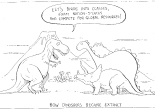
Thumb-nail – click on picture for full-size
This cartoon is by the superlative David Pope (pen name Hinze).
"Those who crusade, not for God in themselves, but against
the devil in others, never succeed in making the world better,
but leave it either as it was, or sometimes perceptibly worse
than what it was, before the crusade began. By thinking
primarily of evil we tend, however excellent our intentions,
to create occasions for evil to manifest itself."
-- Aldous Huxley
"The only war that matters is the war against the imagination.
All others are subsumed by it."
-- Diane DiPrima, "Rant", from Pieces of a Song.
"It is difficult
to get the news from poems
yet men die miserably every day
for lack
of what is found there"
-- William Carlos Williams, "Asphodel, That Greeny Flower"
Thumb-nail – click on picture for full-size
This cartoon is by the superlative David Pope (pen name Hinze).
Testimony from a man who ought to know, this is an important statement that deserves circulation. Diogenes, we found another one! ;)
As we say in Australia, John Dugard, you bewdy!!!
***
APARTHEID: Israelis adopt what South Africa dropped
By John Dugard | 29 November 2006 | The Atlanta Journal-Constitution | IMEU.net
Former President Jimmy Carter’s new book, “Palestine: Peace Not Apartheid,” is igniting controversy for its allegation that Israel practices a form of apartheid.
As a South African and former anti-apartheid advocate who visits the Palestinian territories regularly to assess the human rights situation for the U.N. Human Rights Council, the comparison to South African apartheid is of special interest to me.
On the face of it, the two regimes are very different. Apartheid was a system of institutionalized racial discrimination that the white minority in South Africa employed to maintain power over the black majority. It was characterized by the denial of political rights to blacks, the fragmentation of the country into white areas and black areas (called Bantustans) and by the imposition on blacks of restrictive measures designed to achieve white superiority, racial separation and white security.
The “pass system,” which sought to prevent the free movement of blacks and to restrict their entry to the cities, was rigorously enforced. Blacks were forcibly “relocated,” and they were denied access to most public amenities and to many forms of employment. The system was enforced by a brutal security apparatus in which torture played a significant role.
The Palestinian territories — East Jerusalem, the West Bank and Gaza — have been under Israeli military occupation since 1967. Although military occupation is tolerated and regulated by international law, it is considered an undesirable regime that should be ended as soon as possible. The United Nations for nearly 40 years has condemned Israel’s military occupation, together with colonialism and apartheid, as contrary to the international public order.
In principle, the purpose of military occupation is different from that of apartheid. It is not designed as a long-term oppressive regime but as an interim measure that maintains law and order in a territory following an armed conflict and pending a peace settlement. But this is not the nature of the Israeli occupation of Palestine. Since 1967 Israel has imposed its control over the Palestinian territories in the manner of a colonizing power, under the guise of occupation. It has permanently seized the territories’ most desirable parts — the holy sites in East Jerusalem, Hebron and Bethlehem and the fertile agricultural lands along the western border and in the Jordan Valley — and settled its own Jewish “colonists” throughout the land.
Israel’s occupation of the Palestinian territories has many features of colonization. At the same time it has many of the worst characteristics of apartheid. The West Bank has been fragmented into three areas — north (Jenin and Nablus), center (Ramallah) and south (Hebron) — which increasingly resemble the Bantustans of South Africa. Read the rest of this entry »
Another pair with integrity
Does It Matter What You Call It?: Genocide or Erasure of Palestinians
By Kathleen and Bill Christison | Counterpunch | 27 November, 2006
During an appearance in late October on Ireland’s Pat Kenny radio show, a popular national program broadcast daily on Ireland’s RTE Radio, we were asked as the opening question if Israel could be compared to Nazi Germany. Not across the board, we said, but there are certainly some aspects of Israel’s policy toward the Palestinians that bear a clear resemblance to the Nazis’ oppression. Do you mean the wall, Kenny prompted, and we agreed, describing the ghettoization and other effects of this monstrosity. Before we could elaborate on other Nazi-like features of Israel’s policies, Kenny moved on to another question. Within minutes, while we were still on the air, a producer handed Kenny a note, which we later learned was a request from the newly arrived Israeli ambassador to Ireland to appear on the show, by himself. Several days later, on the air by himself, the ambassador pronounced us and our comparisons of Israeli and Nazi policies “outrageous.”
What else? We were not surprised or disturbed by his outrage. We had just spent two weeks in the West Bank witnessing the oppression, and it was a sure bet that, even had he not been fulfilling his role as propagandist for Israel, the ambassador would not have known the first thing about the Palestinian situation in the West Bank because he had most likely not set foot there in any recent year. In retrospect, we regret not having used even stronger language. Having at that point just completed our fifth trip to Palestine since early 2003, we should have had the courage and the insight to call what we have observed Israel doing to the Palestinians by its rightful name: genocide.
We have long played with words about this, labeling Israel’s policy “ethnocide,” meaning the attempt to destroy the Palestinians as a people with a specific ethnic identity. Others who dance around the subject use terms like “politicide” or, a new invention, “sociocide,” but neither of these terms implies the large-scale destruction of people and identity that is truly the Israeli objective. “Genocide” — defined by the UN Convention as the intention “to destroy, in whole or in part, a national, ethnical, racial, or religious group” — most aptly describes Israel’s efforts, akin to the Nazis’, to erase an entire people. (See William Cook’s “The Rape of Palestine,” CounterPunch, January 7/8, 2006 for a discussion of what constitutes genocide.)
In fact, it matters little what you call it, so long as it is recognized that what Israel intends and is working toward is the erasure of the Palestinian people from the Palestine landscape. Israel most likely does not care about how systematic its efforts at erasure are, or how rapidly they proceed, and in these ways it differs from the Nazis. There are no gas chambers; there is no overriding urgency. Gas chambers are not needed. A round of rockets on a residential housing complex in the middle of the night here, a few million cluster bomblets or phosphorous weapons there can, given time, easily meet the UN definition above. Read the rest of this entry »
Global Research | JK Cook | Also mirrored at Counterpunch and other sites — consider circulating by email or posting on your site | 30 November 2006
Human Rights Watch has lost its moral bearings
NAZARETH. If one thing offers a terrifying glimpse of where the experiment in human despair that is Gaza under Israeli siege is leading, it is the news that a Palestinian woman in her sixties — a grandmother — chose last week to strap on a suicide belt and explode herself next to a group of Israeli soldiers invading her refugee camp.
Despite the “Man bites dog” news value of the story, most of the Israeli media played down the incident. Not surprisingly: it is difficult to portray Fatma al-Najar as a crazed fanatic bent only the destruction of Israel.
It is equally difficult not to pause and wonder at the reasons for her suicide mission: according to her family, one of her grandsons was killed by the Israeli army, another is in a wheelchair after his leg had to be amputated, and her house had been demolished.
Or not to think of the years of trauma she and her family have suffered living in a open-air prison under brutal occupation, and now, since the “disengagement”, the agonising months of grinding poverty, slow starvation, repeated aerial bombardments, and the loss of essentials like water and electricity.
Or not to ponder at what it must have been like for her to spend every day under a cloud of fear, to be powerless against a largely unseen and malign force, and to never know when death and mutilation might strike her or her loved ones.
Or not to imagine that she had been longing for the moment when the soldiers who have been destroying her family’s lives might show themselves briefly, coming close enough that she could see and touch them, and wreak her revenge.
Yet Western observers, and the organisations that should represent the very best of their Enlightenment values, seem incapable of understanding what might drive a grandmother to become a suicide bomber. Their empathy fails them, and so does their humanity.
Just at the moment Fatma was choosing death and resistance over powerlessness and victimhood — and at a time when Gaza is struggling through one of the most oppressive and ugly periods of Israeli occupation in nearly four decades — Human Rights Watch published its lastest statement on the conflict. It is document that shames the organisation, complacent Western societies and Fatma’s memory.
In its press release “Civilians Must Not Be Used to Shield Homes Against Military Attacks”, which was widely reported by the international media, HRW lambasts armed Palestinian groups for calling on civilians to surround homes that have been targeted for air strikes by the Israeli military. Read the rest of this entry »
See Also:
***
Statement, Al-Haq, 28 November 2006 by way of ei
On 29 November 2006, the international community observes the
International Day of Solidarity with the Palestinian People. As a Palestinian organisation dedicated to the protection and promotion of human rights in the Occupied Palestinian Territories (OPT), Al-Haq takes this opportunity to emphasise that the root cause of the pervasive violations of human rights and humanitarian law in the OPT is the almost 40-year-old Israeli occupation. Both Israel and the international community have repeatedly failed to meet their international legal obligations with regard to the OPT. Consequently, the full realisation of the fundamental rights of Palestinians, including the right to self-determination, remains as distant as ever.
Israel continues to systematically violate, with impunity, international humanitarian and human rights standards in the OPT, as demonstrated by the recent incursions into Beit Hanoun in the Gaza Strip. Since 29 November 2005, Israeli military operations in the OPT have resulted in the deaths of 562 Palestinians, including 44 women and 86 children, and injured many more. Many of those killed were civilians not participating in hostilities. There are no justifications under international law for Israel’s clearly disproportionate and indiscriminate use of force against Palestinians, or for the continuing occupation of the OPT in violation of binding UN Security Council resolutions.
Israel, the Occupying Power, furthermore disregards its obligation to provide for the basic welfare of the occupied population, as illustrated by the recent drastic deterioration of the Palestinian economy and related shortages of food, water and medicine. Approximately two thirds of the Palestinian population now live below the poverty line, many of them children deprived of their basic needs. To aggravate matters, over 150,000 civil servants, upon whom at least one quarter of the Palestinian population depend for support, have only been paid a fraction of their wages since March 2006. This is a direct result of Israel’s retention of Palestinian tax and customs revenues and major donors’ withdrawal of financial aid to the Palestinian National Authority. As noted by John Dugard, the Special Rapporteur on the OPT, “the Palestinian people have been subjected to economic sanctions – the first time an occupied people have been so treated.”
International solidarity with the Palestinian people can be best expressed by ending the aforementioned economic sanctions and ensuring respect for international law. In this regard, Israel’s ongoing construction of the Annexation Wall, development and expansion of settlements, and sustained efforts to annex vast tracts of the West Bank, including East Jerusalem, in open defiance of international law as reflected in the International Court of Justice’s 2004 advisory opinion, must be brought to an immediate end.
At a time when the civilian population of the OPT finds itself denied the fundamental protections of international law, pressure must be exerted on every member of the international community to urgently and unequivocally stand in defence of the rights of the Palestinian people and find the political will to oppose Israel’s persistent violations. Adherence to international law, the ending of the occupation and the meaningful and effective exercise of the right to self-determination by the Palestinian people are essential to achieving a just and durable solution to the conflict.
Chile, Bolivia, Brazil, Argentina, Uruguay, Nicaragua, Venezuela and now, very likely Ecuador: In another electoral turn to the left for Latin America, 43 year-old economist-academic Rafael Correa looks set to win the Ecuador election over his billionaire banana tycoon opponent, Alvaro Noboa.
Ecuador’s Supreme Electoral Tribunal has declared that his comfortable lead is by 67% to his opponent’s 33%.
A left-leaning economist who earned his PhD at the University of Illinois, he has pledged several initiatives that will not exactly please the current Washington administration, nor will his friendship with Venezuela’s Hugo Chávez.
Correa wants a constitutional overhaul, the closing down of a US military base when the lease expires in 2009, doesn’t plan to continue negotiations for a Free Trade Agreement with the US, and has indicated that Ecuador could rejoin the Organization of Petroleum Exporting Countries (OPEC). Ecuador is the Hemisphere’s fifth largest oil producer.
During this, the second round of voting, Correa has notably toned down his rhetoric of debt defaulting, and Latin American watchers suggest that his radicalism may be much overstated. He certainly faces enormous challenges ahead but brings fresh hope and a lot of ideas and energy.
As Stephen Lendman writes in the Atlantic Free Press:
Correa will face huge challenges ahead when he takes office on January 15 in a country of 13 million, over 70% of whom live in poverty and who supported a man promising to help them with the kinds of social programs Hugo Chavez instituted in Venezuela. … He’ll be Ecuador’s eighth president in the last decade including three of them driven from office by mass street protests against their misrule.
… Correa said he’ll deliver a “citizens’ revolution” and supports beginning it by calling for a constituent assembly to write a new constitution, a pattern similar to the one Hugo Chavez followed after his election as Venezuela’s president in 1998. He called for renegotiating the country’s $16 billion foreign debt and hasn’t ruled out an Argentine-style default to free up money for vitally needed social programs that include 100,000 low-cost homes, doubling the $36 “poverty bonus” 1.2 million poor Ecuadorans receive each month and raising the minimum wage.
He also expressed strong opposition to any new “free-trade” pact with Washington on its one-way terms and affirmed his determination not to renew the lease for the US military base in Manta he said he won’t allow to remain open unless the Bush administration allows his country the right to have its own in Miami – a clear sign of his contempt for George Bush he called “dimwitted” in the first electoral round.
Rafael Correa faces an uphill struggle to help his people. He’ll have strong opposition in Ecuador’s legislature as well as a hostile Bush administration that will do all it can to subvert him. He does have a few things in his favor, however, he can exploit to advantage – overwhelming support from his people, the nation’s oil wealth giving him a measure of independence from Washington and the international lending agencies it controls and two very supportive and friendly neighbors in Hugo Chavez (he promises closer ties with) and Evo Morales in Bolivia. The ball is now in Mr. Correa’s hands, and it’s his move to show if he can run with it.
Peoplesgeography wishes him and the people of Ecuador well and watches his election with interest.
Hala Jaber reflects on her experience of Lebanon during the civil war and her fears for the future of her compatriots
The Australian | November 27, 2006
AS 100,000 mourners packed Martyrs’ Square in the centre of Beirut last Thursday for the funeral of Pierre Gemayel, the murdered Christian industry minister, leading members of Hezbollah gathered in sparsely furnished offices in a dusty southern suburb and stared intently at their television screens.
They watched with studied indifference as the crowd chanted “Down with Syria”, burnt photographs of Bashar al-Assad, the Syrian President, and accused him of ordering the assassination.
But when the white coffin was borne aloft and the camera zoomed in on the 34-year-old minister’s widow Patricia sobbing in the arms of her equally grief-stricken mother-in-law, Hussein Rahal, a senior Hezbollah official, was pricked by emotion.
“As a husband, I couldn’t help thinking this could be my wife,” he said. “As a father, my heart went out to the family whose loss of a son will be immeasurable.”
His comment revealed an unexpected personal affinity between sworn political enemies — the Christian elite on one side and leading Shia radicals on the other. Hassan Nasrallah, Hezbollah’s secretary-general, whose eldest son died in a raid on an Israeli position in 1997, telephoned Gemayel’s father, Amin, a former president, at the weekend with his condolences and the two men talked about their lost boys. Yet there is little room for sentiment in Lebanese politics.
The funeral took place on the day Hezbollah had been due to call a million supporters on to the streets with the aim of toppling the Government in which Gemayel served. No sooner had he been laid to rest, the group’s leaders began calculating how soon they could reactivate their plan.
Officials refused to say what had been decided, but the indications were that once seven days of mourning have been observed, their supporters will prepare to march on the Lebanese parliament to demand the resignation of Prime Minister Fouad Siniora.
Syrian-backed Hezbollah and its allies — including the Free Patriotic Movement of Michel Aoun, a Christian general — claim that with 57 of the 128 seats in parliament they are entitled to 44 of the posts in Government, but had to put up with 25 until their six cabinet ministers resigned earlier this month. Read the rest of this entry »
See also Civil War in Iraq Near, Annan Says: Study Group Begins Two-Day Meeting
A book review by Mark Danner follows
State of Denial: Bush at War, Part III | by Bob Woodward | Simon and Schuster, 560 pp., $30.00
The One Percent Doctrine: Deep Inside America’s Pursuit of Its Enemies Since 9/11 | by Ron Suskind | Simon and Schuster, 367 pp., $27.00
State of War: The Secret History of the CIA and the Bush Administration by James Risen | Free Press, 240 pp., $26.00
Today, if we went into Iraq, like the president would like us to do, you know where you begin. You never know where you are going to end.
—George F. Kennan, September 26, 2002[1]
I ask you, sir, what is the American army doing inside Iraq?… Saddam’s story has been finished for close to three years.
—President Mahmoud Ahmadinejad of Iran to Mike Wallace on Sixty Minutes, August 13, 2006-
In the ruined city of Fallujah, its pale tan buildings pulverized by Marine artillery in the two great assaults of this long war (the aborted attack of March 2004 and then the bloody, triumphant al-Fajr (The Dawn) campaign of the following November), behind the lines of giant sandbags and concrete T-walls and barbed wire that surrounded the tiny beleaguered American outpost there, I sat in my body armor and Kevlar helmet and thought of George F. Kennan. Not the grand old man of American diplomacy, the ninety-eight-year-old Father of Containment who, listening to the war drums beat from a Washington nursing home in the fall of 2002, had uttered the prophetic words above. I was thinking of an earlier Kennan, the brilliant and ambitious young diplomat who during the late 1920s and 1930s had gazed out on the crumbling European order from Tallinn and Berlin and Prague and read the signs of the coming world conflict.
For there in the bunkered Civil-Military Operations Center (known as the C-Moc) in downtown Fallujah, where a few score Marines and a handful of civilians subsisted in a broken-down bunkered building without running water or fresh food, I met young Kennan’s reincarnation in the person of a junior State Department official: a bright, aggressive young man who spent his twenty-hour days rumbling down the ruined streets in body armor and helmet with his reluctant Marine escorts, meeting with local Iraqi officials, and writing tart cables back to Baghdad or Washington telling his bosses the truth of what was happening on the ground, however reluctant they might be to hear it. This young diplomat was resourceful and brilliant and indefatigable, and as I watched him joking and arguing with the local sheikhs and politicos and technocrats —who were meeting, as they were forced to do, in the American bunker —I thought of the indomitable young Kennan of the interwar years, and of how, if the American effort in Iraq could ever be made to “work,” only undaunted and farseeing young men like this one, his spiritual successor, could make it happen. Read the rest of this entry »
An advertising campaign to be commended, designed for free by a civil society group, 05 AMAM, worthy of the name ‘civil’ — see their website here, well worth a visit for a look at their campaign billboard and posters hoping to jolt people towards, as various punters in the blogosphere have put it, ’sectual healing’.
***
Ad Blitz Satirizes Lebanon’s Divides
Provocative Signs Target Pervasive Sectarianism
Farcical signs list doctors by sect. “If we keep thinking like this, the future is going to look like this,” said ad agency’s Kamil Kuran. (Courtesy H& C Leo Burnett Agency)
By Anthony Shadid
Washington Post Foreign Service
Tuesday, November 28, 2006; A12
BEIRUT, Nov. 27 — The evening was tense, as most are these days in Beirut, its Maronite Catholics, Greek Orthodox, Sunni and Shiite Muslims and Druze perched imprecisely between war and peace. Malak Beydoun, a young woman, pulled her car into a parking lot in the Christian neighborhood of Ashrafiyeh. She peered at a billboard overhead, alarmed and then indignant.
“Parking for Maronites only,” it read.
Beydoun recoiled. “How did they know that I was a Shiite?” she remembered asking herself.
Part provocation, part appeal — with a dose of farce that doesn’t feel all that farcical — advertisements went up this month on 300 billboards across the Lebanese capital and appeared in virtually every newspaper in the country. Thousands of e-mails carried the ads across the Internet to expatriates. Each offered its take on what one of the campaign’s creative directors called a country on the verge of “absurdistan” — cooking lessons by Greek Orthodox, building for sale to Druze, hairstyling by an Armenian Catholic, a fashion agency looking for “a beautiful Shiite face.” At the bottom, the ads read in English, “Stop sectarianism before it stops us,” or, more bluntly in Arabic, “Citizenship is not sectarianism.”
The campaign, designed for free by an ad agency and promoted by a civil society group, has forced Lebanon to look at itself at a time when the country is spiraling into one of its worst political crises in years. The timing was coincidental, the message universal, in a landscape with ever dwindling common ground: The forces that dragged Lebanon into one civil war are threatening another.
Many have praised the ads for asking uncomfortable, even taboo questions about a system in which sectarian affiliation determines everything from the identity of the president to loyalty to sports teams. Read the rest of this entry »
“Just as none of us is outside or beyond geography, none of us is completely free from the struggle over geography. That struggle is complex and interesting because it is not only about soldiers and cannons but also about ideas, about forms, about images and imaginings.”
Edward Said (1994)

